
On a String
Suzuki-Method Actor: Isabel Hagen’s Hilarious, Hyper-Personal Debut
Credit: Isabel Hagen, Joke Zero
Writer/director/actor Isabel Hagen’s plucky, hilarious debut On a String follows a Juilliard-trained violist coming of age in New York City. Hagen—herself a Juilliard-trained violist and stand-up comedian—plays a fictionalized Isabel, infused with personal truth. Balancing observational humor and genuine poignancy, this delightful first feature hits all the right notes.
Post-grad Isabel still lives with her family, plays gigs with a string quartet, and dates immature men. But relatability doesn’t end there. Her nagging sense that something must change pushes her toward external fulfillment—often in the wrong places.
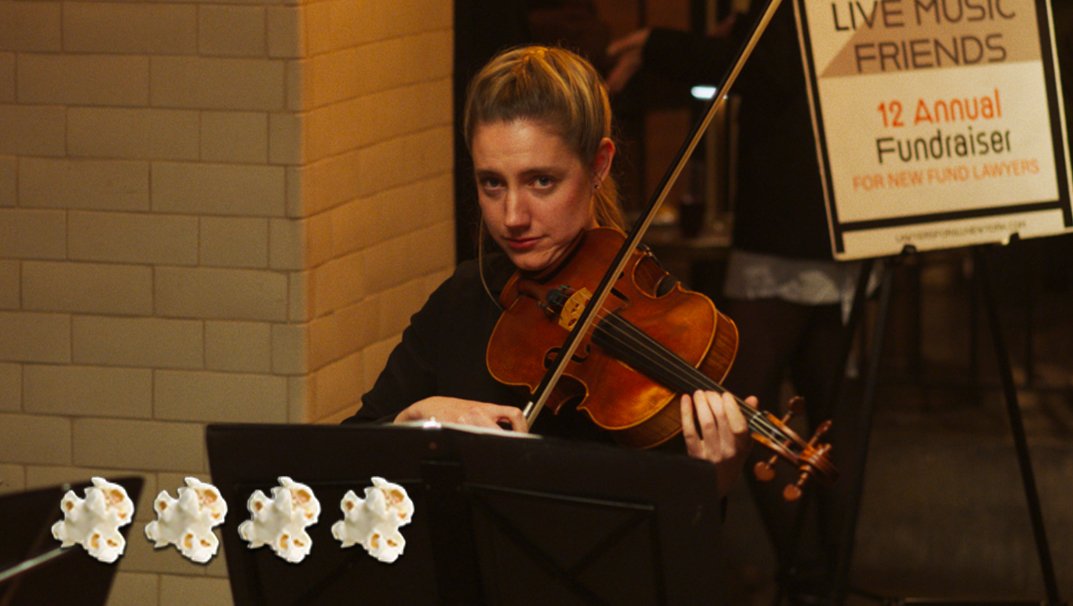
First-in-line is her quartet. All gifted musicians-for-hire—including best friend/closet rival Christina (Ling Ling Huang)—they serenade a painful series of clients. Newlyweds, mourners, the creepy uber-rich, their listeners are far from appreciative. Hoping for validation, Isabel stumbles from one to the next.
Then we meet her eccentric family. Meditating to symphonies at max volume are Isabel’s filter-less mom (Karen Blood), commiserating dad (Dylan Baker) and pompously OCD brother (Oliver Hagen, a real-life sibling). Their own musical ambitions thwarted, they try to encourage Isabel—but their misguided comments often make her feel less-than.
Last and most loathsome are the men in her life. Ranging from crybaby to predatory, each one reflects Isabel’s frustrated yearnings. Former boyfriend (Jack Zittel) continues to cling; hotshot cellist David (John Kroner) ignores her overtures; her student’s father, Carl (Frederick Weller) pays TOO much attention—to his wife Trisha’s chagrin (Jamie Lee).
When Isabel auditions for the Philharmonic—initially to impress a crush—On A String threatens to become predictable. Thankfully, Hagen refuses to go full underdog. In only seventy-eight light-footed minutes, her narrative prioritizes a circuitous search for fulfillment over histrionics: no threat looms greater than Isabel’s own decisions.
All of them—some naïve, some inevitable, all painfully awkward—serve as catalysts for personal evolution.
Structurally sound without feeling by-the-numbers, Hagen’s script (a 2025 Tribeca screenwriting award-winner) feels akin to Cleo 5 à 7, Frances Ha and Sorry, Baby in its meandering, personal lens. Isabel’s episodic, gig-driven life lets the film breathe like a stand-up set: if one punchline doesn’t land, another is coming.
Uncomfortable close-ups and embarrassing silences capture idiosyncrasies: the faces that musicians make at each other mid-performance; the politics that plague liminal performance spaces; the effort to disguise anger with offers of help. A perfectly-timed elevator confessional is among the film’s comedic highlights, showing director Hagen’s talent for staging her actors.
At the center of it all is Hagen’s finely-tuned performance as Isabel. Unlike many self-cast actors, she resists giving herself the splashiest material; her reactions often speak louder than her lines. Through subtle facial shifts—a hopeful grin that turns crestfallen, a half-baked gesture that ends in paralysis—she makes Isabel easy to root for. All while generously gifting memorable moments to her supporting cast: corporeal expressions of off-key behaviors that Hagen has deftly explored in her stand up. Her real-life brother Oliver as her onscreen brother Owen is a scene-stealer.
Isabel’s romantic interests are the weakest link by design. Their inadequacy is the point—and their cringeworthy performances take them beyond caricature into tragic territory. Squirmy as they may be, they’re a small price to pay for Isabel’s growth. Plus they feel all too familiar to anyone who has tried dating in NYC.
Even the quartet’s virtuosity adds humor. While sputtering through lame gigs, their skill commands genuine admiration. Hagen’s viola is expertly deployed, echoing Isabel’s interiority with a performance of its own, ranging from flat to bravura depending on mood. Will Canzoneri’s score is equally dynamic: pitch-perfect and understated when necessary (with collaboration from Hagen).
On a String feels like a synthesis of Hagen’s past lives into something far greater. Her screenwriting and directing are clearly born of past stand-up: well-honed observations of human behavior, real-life fusions of self-awareness and self-deprecation. In print and in interviews, Hagen has blasted the demands of digital culture, a system that rewards noise over artistic merit; here, she operates with quiet confidence. Human frailties followed by small revelations make On a String sing. While sharing the pain of Isabel’s journey, Hagen gives us music and laughter—unexpected oases that make our own search for fulfillment far more bearable.

Reviewed at Tribeca Festival 2025, on June 13th.
78 min.
Where to Watch: Release coming this fall.